
I remember that I was so excited to share what I had learned with my church ladies Bible study group. I had spent hours studying the book and passages and thinking about how to explain them in a way that would encourage discussion. As I began to speak, I noticed two women exchanging quiet glances. Their laughter was soft at first, barely audible, but it carried a weight that made me tense. Every word I spoke felt like a high-stakes examination where failure was not just an error, but a reflection of my character. They were intent on catching me in a mistake. When one of them finally asked a loaded question, not seeking clarity but looking to prove a point, I answered as best I could, keeping a practiced smile on my face. That night, I lay awake, replaying the interaction over and over, convinced I had failed not just as a person, but as a leader, and as a Christian. In the rigid world of the high-control church, where failure was treated as sin, being wrong was never seen as a chance to learn. Any mistake was seen as evidence of spiritual weakness. This mindset, which equates human error with moral failure is corrosive!
I think back to the years when the fear of failure felt completely normal. I was always trying so hard to get everything perfectly right. Whether it was in church, at work, in my marriage, and even in motherhood, I measured my worth by how successfully I could avoid mistakes. I didn’t realize it then, but this crippling self-assessment had deep roots in the high-control environment where failure was constantly treated as sin. It wasn’t until I recently read the words, “When you treat failure as information, not shame, you turn every loss into a stepping stone,” that I felt something seismically shift inside me. It was such a simple idea, yet one that felt almost revolutionary after a lifetime in an environment that did not allow room for failure. In the high-control IFB world, failure was often equated with sin. Mistakes were not opportunities to learn or grow; they were moral shortcomings that required repentance and often brought judgment or exclusion.
Looking back, I can see how deeply this mindset affected me. I learned to fear missteps, to hide imperfection, and to measure my worth by how well I appeared to uphold every rule and expectation. The problem was that this kind of life left no space for grace. It taught me to equate being human with being wrong, and it made growth nearly impossible. When failure is viewed as sin, curiosity and creativity shrink. People become afraid to try, afraid to question, and afraid to be honest about their struggles.

Now that I am outside that environment, I can see that failure is not a spiritual flaw but part of being alive. In fact, it is one of the most powerful teachers we have. Failure gives us data. It helps us see what does not work, what we might try differently next time, and where our true strengths lie. When we approach failure with curiosity instead of condemnation, we move closer to wisdom and compassion, both for ourselves and for others.
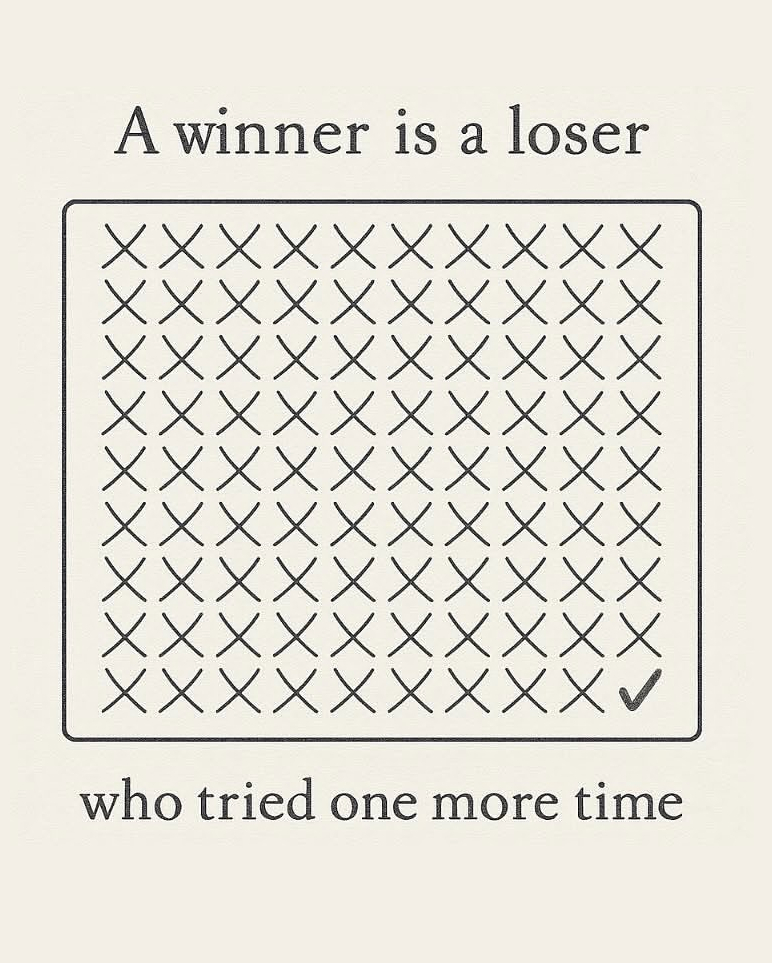
God’s grace is not conditional on perfection. If anything, grace assumes imperfection. The difference between shame and truth and growth is that one crushes the spirit, while the other restores it.
Even now, years later, the memory of that Bible study, with the exchanged glances, shared snickers, and the pointed question, still carries a faint sting. The difference is that I no longer replay the conversation to find the moment I “failed” as a leader or a Christian. Instead, I see that moment not as evidence of my spiritual weakness, but as an illustration of the corrosive power of a system that equated humanity with deficiency. My shame has been replaced by a sense of compassion for those two women, who were and still are trapped in the same rigid mindset. They were merely following the rules of a game we had all been taught to play, desperately measuring their own worth by the errors they could expose in others and the mistakes they could avoid. When we refuse to internalize judgment, we find the grace to extend it outward. Failure no longer defines me; it refines me.
Now, I try to live in a way that honors learning over fear. I still struggle with trying to be perfect, I still make mistakes, but instead of hiding them, I try to ask, “What can I learn from this?” Every time I do, I feel freer. Failure no longer defines me; it refines me. And that, I believe, is where grace truly begins.

Disclaimer: The personal experiences shared in this post are based on my personal perspective. While I chose to leave the IFB to find a more gracious and loving faith, it is important to acknowledge that individuals may have different experiences and find happiness within the IFB or any other religious institution. The decision to leave the IFB does not imply a loss of faith, as faith is a deeply personal and subjective matter. It is essential to respect and recognize the diversity of experiences and perspectives within religious communities. The content shared is for informational purposes only and should not be construed as professional advice, guidance, or a universal representation of the IFB or any religious organization. It is recommended to seek guidance, conduct research, and consider multiple perspectives when making personal decisions or exploring matters of faith.

 Looking Joli Good
Absolutely! I wouldn’t give up my life full of failures for anything! Where else could I turn to find “choice, change and success?!”
LikeLiked by 1 person
That was very well stated, speaking as one who has been freed from the chains of that mindset. My worth is in the knowledge of God’s love for me, not in making myself look better than others. God’s grace is a wonderful thing!
LikeLiked by 1 person